Saturday, October 22, 2011

Day 15 & 16 - Okavango Delta

Small Crocodile on the side of the bank as our mokoro went by.

 Mokoro Island - Xaga Island

“Do you hear that noise?”
“No, Barb.  I don’t”
There is a pause.  Then after a longer silence, Barb speaks again.
“Well, do you hear that?”  Her voice is excited, even nervous.  Due to my “greater than a standard deviation hearing loss”,  I still hear nothing unusual.

We are camped on a very small island in a tropical African marsh.  The normal inhabitants of this small piece of earth have left evidence of their presence all around us .  Not 15 steps behind us, the bush and papyrus are compressed where some very large animals like to bed down for the night.  All over our little island (once called by the San people Xaga) are bowling ball, even basketball, sized excrement left by the same very large animals.  Many of the trees in our campsite are scraped by Bull Elephants in order to mark their territory.  Elephants and Hippos live here.  This is their turf.  We are the intruders.

Elephant dung all over our camp site.  It's huge!!!
“Now. Did you hear that?”  I heard a little something that time.  “Maybe it’s Chuck and he’s already asleep”, I tell Barb.  She looks at me as if she is not sure how to deal with her dim-witted husband.  Then she looks worried, as now there is an obvious, loud sound from just outside the tent.  With that sound, even I have to admit that it could be a hippo.  And it’s not the hippo’s deep and slow grunting that can pass for a man snoring that is causing her apprehension.  It’s the crashing-through-the-papyrus-just-outside-the-tent sound that makes her so concerned.  Suddenly I can hear all of the sounds.  Now the elephant’s trumpeting, and the hippo bellows and grunts, and the water and papyrus crashing sounds soon have my blood pressure and pulse completely off the charts.  Fight or flight is supposed to be the danger response.  But flight is not possible when you are on a small island in a large swamp.  Fight is not an option with the huge animals that live here, so I choose Fright as my option. 

We have been assured by our guides that we will be safe in our tents.  Tents are seen as objects, like rocks, by the animals and will be avoided is the story we are told.  It’s not a theory I really want to test.  Nervously, I step outside our tent to check with the guide.  Some might say I was looking for reassurance.  Of course adult males, particularly retired pilots, do not do such things.  However, Brett is a trained naturalist and researcher, and I thought I might graciously give him an opportunity to show off a little.  He is a younger man with much to learn, but does have some knowledge in these areas.  In response to my question about the noises, he affirmed that it was hippos and elephants that we were hearing.  After all, this was their normal habitat and the hippos are nocturnal creatures.  As he stirs our comforting campfire, he states “They won’t come on the island so long as we keep the fire going,”.  I am reassured and now confidently turn back to our tent to tell Barb that all will be okay.  But then Brett continues, “ Of course, once the fire goes out, they’ll probably come onto the island and maybe even through the campsite.”  I think now that it’s going to be a very long night, as I resolve that I will not leave our tent until sunrise, no matter how much I may need to relieve myself. 

Today had been a very long one for us.  It began back at Guma Lodge on the edge of the Okavango delta.  Shortly after breakfast, we loaded our gear onto one large flat bottomed skiff,  and ourselves onto another.  We were seated on bench seats that are not even attached to the floor of our small boat.  The boat is necessarily shallow draft for the marshes, about 10 ft wide by 25 ft long, shiny aluminum, and is powered by a very large Mercury outboard motor.  Although the open water of Guma lagoon seems large, it is not long after leaving the dock that we are entering a large channel bordered mostly by papyrus reeds. Our course seems to be generally south.  We are told that the trip in the boat will take approximately 40 minutes to get to an island known as Mokoro Island.  Mokoro is the name of the dugout canoes that were used by the native inhabitants of this marshland.  And Mokoro Island is where we will stop to change from our simple, modern craft, to the dugout canoes that can still be found in use deep in the marsh.  Descendants of the Bahei(?) people that once lived in these swamps will be our polers (pronounced pol-luhrs).  These people have moved out of the delta and into villages ashore in order to escape the Tsetse fly.

Leon and our 'poler' Masta in the Okavango Delta.
The channel continues to narrow.  Now it is also bordered on one side by occasional cane and trees that indicate the presence of the small islands characteristic of this delta.  At one point, our driver completely stops in the channel, and then turns off the engine.  He sits there for a moment, restarts his motor and turns sharply into a very small channel that is only wide enough for one boat.  He had stopped to listen for the sound of other boats that might be in the channel.  The water that we see is surprisingly clear.  We are told that the reeds are a natural filter for the flowing river water.  This narrow, twisting channel leads us to an inlet on Mokoro Island.  Our supply boat is already beached and partially unloaded.  Our polers are all young black men, their builds varying only slightly.  They are from 5’8” to about 6’.  Most are very slim with lean yet muscular builds.  Our poler, Masta, is one of the shorter ones, but with unusually broad shoulders when compared to his friends.  He speaks very little English, and seems younger than the others.  But later, farther into the marsh, we will see the lead guide Simon referring to Masta for advice.

Leon & Masta in our mokoro with the rest of the group following.
The canoes set out into a channel even narrower than before.  The water is much shallower in most places, and the reeds and water lilies leave very little room for passage.  Oddly though, when compared to the marshes and bayous of my native Louisiana, there is a strong current moving through this clear water.  Soon, we are not even in defined channels or paths.  The boats are being pushed over thick reeds from one clear area to another.  Sometimes, we must retreat and try to find a different path. 

Our polers use these mokoro’s expertly.  Pointed at both ends like a canoe or pirogue, they are generally flat bottomed.  The sides are hard chined, with some inward sloping tumblehome at the very top.  The pole is used as an oar, a tiller and a push pole.  The poler will deliberately tilt the boat left or right just as a kayaker does to aid in the turns.  They sometimes deliberately run the boat up onto some reeds, and as the boat slides off to one side, they will pivot it into a tight turn.  The other advantage of poling is that by standing they can see where the channels might be.  When the chosen channel proves impassable, they can see where they need to go to find a better one.

Our mokoros, dugout canoes used to travel in the Delta's marsh land.
There is suddenly some chatter between our polers.  Simon asks us to be quieter.  It is unclear why he wants silence until we also begin to hear the faint, but not distant, sounds of large animals moving through the marsh.  Soon there is the sound of an elephant’s trumpeting.  It is very close.  We can see the tops of some trees moving.  But our polers, after talking among themselves, begin to lead us away from the sound.  Perhaps it is too dangerous to approach these elephants.  In our ignorance, we are worried that we have missed a chance to see the elephant in the wild - unconstrained by fences - where they are rarely bothered by humans.

This guy is as big as a house!!!
What is soon clear to us is that our guides are circling around this island to approach it from another angle.  The new approach will place us downwind from the elephants, so that they will not be alarmed by our scents.  Dan and Chuck are in the lead boat with Simon.  Barb and I are in boat number two, and Jeff and Meghan are in number three.   There are three other boats following us, but our position in this line of boats will soon prove critical and fortuitous. 

There is an island not a 100 yards distant, with trees and brush.  Between us and that island stands only the constant and thick growth of papyrus which greatly reduces vision when seated in the low boats.  The guides are now homing on the sounds.  The lead two boats come to a break in the reeds.  Suddenly, there is a clear sighting of this massive elephant.  He seems to be impossibly tall, towering over the lower trees that are at least fifteen foot high.  And his movements are not those slow, languid movements of the desert elephant, but quick and powerful in a way that fills me with awe and some fear.  At first, he is oblivious to us.  Our shutterbugs were ready and are firing away.  Dan is the chief shutterbug on our trip, sharing his excitement and expertise with all.  Barb and Chuck are two shutterbug wannabees whose enthusiasm is fun to watch.  All of us are amazed at what we are witnessing.  A wild elephant in his natural element, where we are the intruders.  The bull suddenly seems aware of our presence.  He turns and looks straight across the water and through the reeds to our small craft.  Pausing, he is obviously considering how to deal with us, the intruders into his realm.  For me, it is a incredible moment as this other highly intelligent creature decides if he should bother ridding his home of the human pests.  Fortunately, he decides we are not worth the trouble, then slowly turns, and walks proudly away from us.  It is one of those lifetime moments that Barb and I will remember forever.  Only the lead three boats were able to share this opportunity.  Due to the reeds, the others did not have a clear enough sighting.  But what great good fortune for those few of us who did.

From this island, our polers begin to take us more directly to Xaga (pronounced Aha) Island.  It will be our base for the night.  When we arrive, we unload, make camp in the sweltering heat and humidity, and try to  relax some from our excitement.  Chuck is soon seen walking to the dugout canoes, and pushing one into the water.  This is okay with our polers even though they need these craft to make their living.  My guess is that they believe they will get a good laugh out of watching us try to do those things that they make look easy.  Well, they will be disappointed then by Chuck.  He seems to be a natural at maneuvering these small, clumsy boats.  Just like the polers, he makes it look easy.  Well, if it is that easy, then Leon has to try.  Surprise.  It’s not as easy as it looks.  Although I do manage to keep from falling into the water, I am sure I provided plenty of laughs for our polers.

Leon and Chuck trying to pole a mokoro in the Okavango Delta.
 After our rest, we head back to the canoes for a late afternoon trip.  I am not sure of the purpose.  But the morning’s pattern almost exactly repeats itself.  We pole into narrow and shallow channels around innumerable small islands.  Our polers hear sounds before we do.  They approach from one direction, identify the sounds as hippopotamus, and begin to pole away.  Hippos, although herbivores, can be very dangerous.  The polers circle around to enter from another direction.  This time, it is a pool of open water where the hippos are bathing.  We slip quietly into the border of reeds around the pool.  Our boats are now aligned side by side, allowing everyone to view the pool that has five hippos playing and moving around.  Time passes too quickly and the sun is beginning to get low in the sky.  Even our most ardent shutterbugs are now rationing the megabytes on their flash drives.  Two of the hippos have left the pool, including the big bull, when one of the smaller ones surfaces, faces our boats, and gives that huge, full, impossibly open mouth that they are famous for.  It is the shot that many of our shutterbugs had been hoping for, but only Barb and a few others managed to capture it.  I believe that all of us there - possibly even our polers and guides - captured that feeling of a special moment in our lives.  A moment where we sat quietly in a swamp in southern Africa, watching hippos playing in their pool.

A pod of Hippos. 
Day 16 - Okavango Delta (Xaga Island) & return to Guma Lagoon

The noises of the morning on our little island are different than the night.  The sounds of elephant and hippo are gone.  The sounds of the morning are now primarily the bird sounds that we have heard for the last two mornings in the delta region.  There is a second softer sound that at first is not noticed.  It is difficult to identify.  To me, it seems to be the sound of millions of insects that often infest other marshy areas I have experienced.  Too often, those hordes like to dine on human flesh and blood.  I am quite worried about going outside, and do not want to encounter such a multitude of bloodthirsty creatures.  But other campers are up and about, and no one is cursing the bugs.  I must be wrong.  Once outside the tent, there are no bugs or mosquitoes to be seen.  I will always believe that the sound we heard is the hum of life from the vibrant multitudes found in the swamp.

We are soon re-packed, and poling away.  Our destination is another island for a nature walk.   We are told that after the walk, we will go to the swimming pool.  The pool sounds good to me.  Having listened to the sounds of nature for most of the night, I am not that interested in another “nature walk”.  However, when you travel with a group, you consent to the group activities.  The dugout canoe trip through the swamp is the same as before, dodging bushes and reeds as our polers move us through very small channels. When we get to the destination island, we can all hear the elephants.  The nature walk is cancelled.  When the elephant is there, it’s his territory.  But we land on this island anyway, and move closer to see him.  For all of us, he is now in full view standing in front of a few trees of about 50 ft in height.  He moves slowly around to the back of the trees.  Now out of our sight, I suddenly see the largest of the trees being shaken and moved as if it were a small bush being shaken by a large strong man.  The power of that elephant to move that tree is incredible.  We are told that he could just pull or push it down to the ground if he wished.  Instead he is shaking it for some other purpose.

It was an amazing site to see elephants our on a walk in the bush.
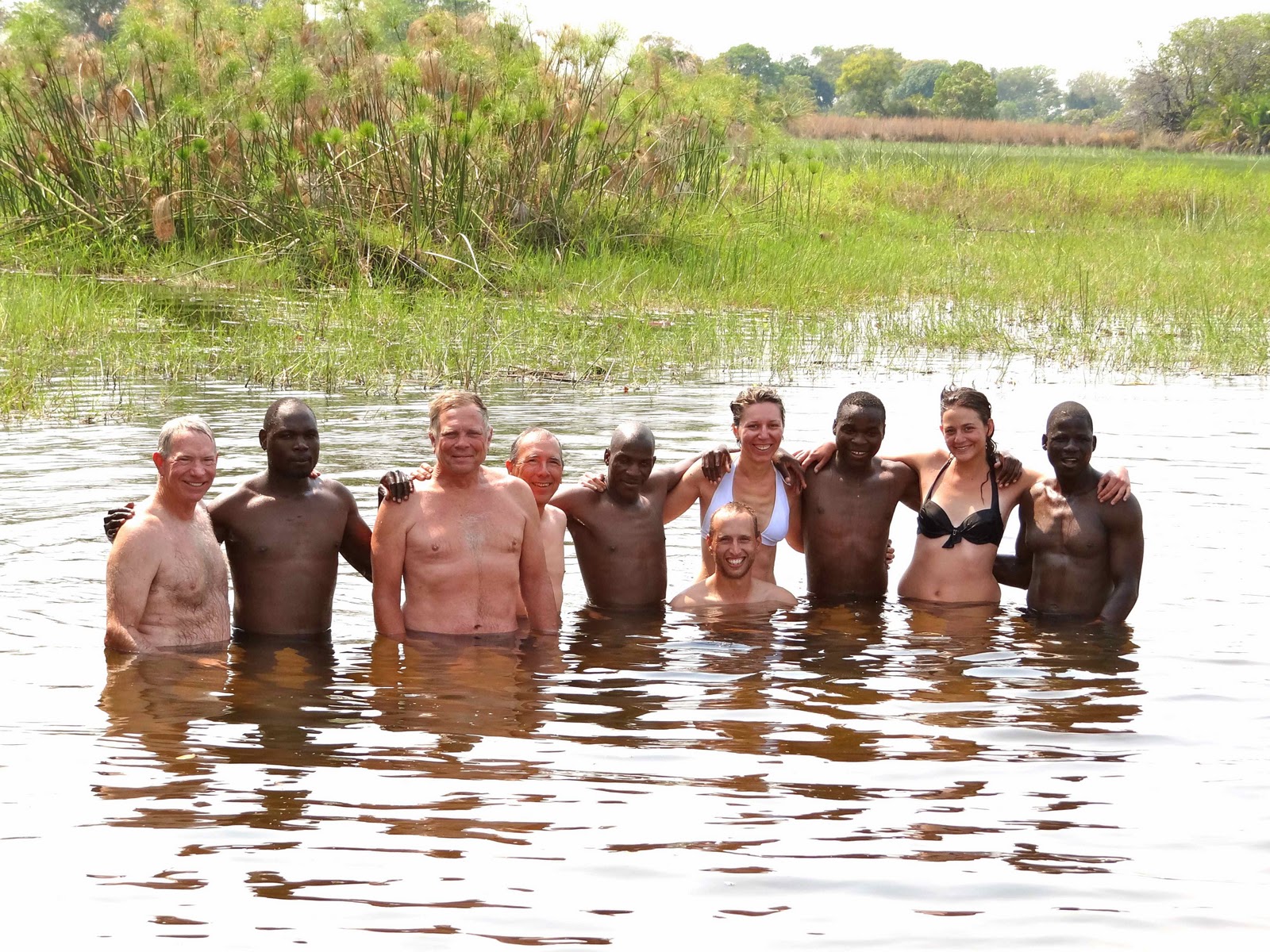
Leon & Dan swimming in the Delta.
Soon after, we are in the canoes heading towards the “swimming pool”.  It turns out to be a small area in the delta, where the water is very clear, the bottom is sand and the trees are shady.  The size and depth are just right for a quick dip in this clear, cool, refreshing pool of water.  Our guides / polers strip to their shorts and jump in.  Soon they are playfully diving and somersaulting into the water.  That quickly develops into somewhat of a contest between them.  One of our party swims to the other side and perches in the limb of a tree.  All of us who will swim and play in this pool enjoy its refreshingly pleasant waters.

The polers having fun at the 'swimming pool'.
The brave ones who decided to cool off in the Delta.
 The rest of this wonderful day is similar to the first one.  We meet the powered skiffs, and return to the lodge for dinner, drinks, and good company.  Tomorrow, we will travel to the town of Maun, before completing the long transit to Chobe National Park, still in Botswana, but just south of the Caprivi Strip.  Two days will be spent at Chobe.

Our trip to the Okavango Delta; our long night on Xaga Island; the intimate sightings of the elephants, hippos, crocodiles and more; are one of the highlights of our trip.  That first encounter with the Bull Elephant in his element is a lifetime event.

Leon & Barb in the Okavango Delta, Botswana.

The following tale was told to us by Simon, our lead Makoro guide.  Standing on an island deep in the Okavango Delta lands, he spoke in his soft, rhythmic, voice.


A Hippo showing that he has no fishes in his belly, or yawning.
In the early days of the world, when the earth and all its creatures were new, the hippopotamus was a land animal and an omnivore that ate anything it could find.  But it was large and hairy and lived in a hot and tropical place.  One day, it found that the pools of water where it went to drink were very cool.  So, the hippos began to spend the days in the waters.  When the creator saw what his hippos were doing, he called them aside to talk to them.  You are a land animal, he said, and you must not live in the waters.  But the chief hippo told the creator that they were very hot on the land and needed to be in the water.  The creator told them that he was the lord of all the creatures and that the hippos would eat the fishes that He had made to live in the waters.  So, the hippos were forced to live only on the land.  They went about the land during the night.  But even in the shade of the trees, they could not stay cool during the day.  The chief of the hippos went to the Creator once again and pleaded to live in the waters to stay cool.  He promised the creator that they would not eat his fishes, but would eat only the plants.  He said that the hippos would all open their mouths very wide so that the lord could see that they had not eaten his fishes.  But the lord replied that his hippo was very large and could hide those fishes in his body.  The chief hippo went away again.  Soon he was back to talk to his Creator.  He told Him that from now on, he and all other hippos would spray their dung on the bushes and trees where the lord could see it.  And if he looked, he would be able to see that all they had eaten were plants and grasses.  The Creator agreed with this.  Thereafter, all of the hippos have been able to stay cool in the water during the day, and they have never since eaten any of the lord’s other creatures.

Happy Feet on Guma Lagoon.

Wednesday, October 19, 2011

Day 14 - Ngepe Lodge to Guma Lagoon


Kavango River, Namibia to Okavango Delta, Botswana

It is a inland tropical African pre-dawn.  The sounds are like nowhere else we have ever been.  Animal sounds range from roars to bellows to insects and birds and reptiles.  One sound is a definitely a hippopotamus.  The other is more menacing.  Do crocodiles make loud noise?  There are the ever present, and surprisingly loud, frogs.  There is a bird, the Swamp Boubou, that sounds like a beeping truck as it backs up.  Of course it is perched just outside the reed walls of our tree house.  And then there is the one that sounds like your smoke alarm low battery alert, and occurs with about the same frequency.  As we lie in our bed on the banks of the Okavango River, protected by mosquito netting, we can view the river flowing by in the predawn light.  It is an exotic, yet still primitive, setting.  We are in the tropics.  This hut only protects from wind and rain.  Its walls are of reed and the roof is thatch. Two of the walls are a reed curtain that we will keep rolled up all evening.

Our treehouse at Ngepe
Our view of the Kavango River from our tree house
Here in inland Namibia, the primary worries are insect borne diseases such  as malaria, the tsetse fly, and the crocs and hippos in the river.  Just last month, a young boy was taken by a crocodile from his dugout.  As for malaria, travelers can take medicines.  But the locals cannot, for they are powerful meds with long term side effects.  Leon is particularly worried about the malaria.  He has stopped taking the Malarone due to his reaction to one of its strong side effects.  Our bed had mosquito netting.

Today is another transit day, but with a very late start of noon.  Breakfast is not even until 8 o’clock.  We will head south to Botswana, leaving Namibia.  Except for the border offices and the fences at the border, it is hard to tell the difference between Botswana and inland Namibia.  It is flat with low trees and dry brown grasses.  Think South Texas with slightly different vegetation.  The villages and their homes remain clusters of small rondels, surrounded by fences of brush pushed up against small upright twisted and disformed logs.

Botswana is poor.  There is no other way to describe it.  Yet its people that we will meet as guides, workers in the lodges, and in other ways, will be friendly and nice.  The local language is Tswana, and the currency is the Pula.  Our road to the camp at Guma Lagoon is one of the worst yet.  We leave the Botswana super highway for a worse unpaved road.  This leads us to a small village where we will transfer some of  our equipment and ourselves to two small Land Cruiser trucks that were once white.  Both are old, well used, and fitted with rooftop air intakes.  Their metal bodies is cracking in places from fatigue, and the repairs are done with sheet metal patches and pop rivets.  Once we are on the “road” leading into the camp, I will quickly understand the fatigue cracks.  One of the trucks has three sets of bench seats to hold 12 of us.  It is a very tight fit.  The other is stacked impossibly high with a subset of our personal gear, plus the tents, food, and cooking equipment.


Village is just a term used to describe a cluster of homes, a school, and a few things that might be stores.  It is not a village as we would imagine it, but it is a place where people live.  Some of the homes are the traditional rondels; most are cement block with rough mortar inlaid between the blocks.  There are outhouses for sanitation, but they are not what you will find in our parks at home.

The road into the camp is not a road but tracks through the land.  There are low 30 foot trees, both acacia and thorn.  There is low, shrub like brush, and the sandy soil is white and gray.  It does not look fertile.  When one track becomes impassable due to the depth of the ruts in the sand, another is started.  Consequently there are many paths to choose from, but only one is the current right choice.  There are numerous signs to the Guma Lagoon Lodge, again on rough wood with cheap white paint.  When the rains come later in the season, much of this area will then be flooded.  Our driver is skilled and friendly with a round face and a good smile. He is wearing a plastic band like a Livestrong band, but this is labelled Mosquito Band.  I am pretty sure that I want one of those.

The road to Guma Camp
After 40 minutes of driving through the land, we arrive at some rough wooden gates and a sign that announces Guma Lodge.  Just inside the gates are a number of buildings made of rough wood and poles, with green canvas siding and roofs.  There are women there, and children playing.  The same architecture and building materials are used throughout the camp and lodge buildings.  It is very practical for the environment that people must live in and endure.

Enjoying the view of Guma Lagoon
Here it is not only hot, but as we are now on the Okavango Delta, it is also very humid and muggy.  The Kavango river forms in interior southern Africa, and does not flow to either the Atlantic or Pacific.  Instead it flows south to this delta land where the waters of a great river are absorbed into the earth, or evaporated into the air.  This delta land is in what would be a naturally arid climate with little rainfall, and a very high evaporation rate, but it is the recipient of the rains from far north of here in Angola. 

Tomorrow, we will travel by boat and dugout canoe (mokoro) deep into this delta land to see what its interior is like.  There should be crocodiles, hippos, elephants and innumerable birds.  Tonight we will camp near the lodge, eat in a canvas covered pavilion, have drinks by the surprisingly open lagoon, and otherwise relax in this civilized setting deep in a wilderness.  Tomorrow, we will camp out in the open, on an island somewhere deep in the marsh, unprotected from the animals in their natural habitat.  Leon is nervous.  Barb has promised to hold his hand when the elephants roar or a hippo gets too close to camp.

Leon & Barb in Botswana

Tuesday, October 18, 2011

Day 13 - Etosha to Ngepi Camp in Caprivi Strip on Kavango River


We are sitting in Whistling Willie.  It still makes the 90 decibel whistling noise despite the best efforts of Will, the driver.  He installed a new “blower” for the diesel in Swakopmund, but that was not the problem.  The next chance to fix the truck is Victoria Falls, 10 days from now.  For the moment, we are rolling down a Namibian superhighway.  That’s old asphalt, 20 ft wide, with centerline stripes and even outside stripes for the edges.

There are two underlying themes to this adventure of ours.  The focus on photography is what Africa In Focus is all about.  The secondary theme is alluded to by the name of our tour, Desert Wanderer.  That nomadic element is a  part of every African Overland Safari.  In our campgrounds, we encounter travelers from all over the world.  Primarily from Europe and North America, they may also be from Asia and the Middle East.  But it does seem to be a core part of the European view of “how to see Africa”.  They travel in various ways: singly; in bus/trucks (like us); and in caravans of 4x4 trucks and suv’s.  There are companies catering to every one of these methods. The rental trucks and land cruisers that we see often have folding tents mounted on the roof.  These stand about as high as your standard roof trunk, but then unfold to show about a 2 or 3 person tent.  Sometimes, there are two of these tents mounted on the roof of the same truck.  The preferred vehicles seem to be Toyota trucks or Land Cruisers.  We see outfitted Land Rovers also, but not very many.  Their design seems otherwise perfect, but we are told that the reliability is not enough for travelers who must make their destination each and every day before nightfall.

Here in Africa, when you see a 4x4 SUV with an external air intake as high as the roof, it is not for show.  People here think driving on awful roads is normal.  For those roads, all they like to have is a vehicle with high wheel clearance.  But lots of hunters, farmers, wildlife researchers, and game keepers are going truly off road.  Second, there are real reasons not to want to spend the night except in desirable places.  The animal wildlife can be dangerous, and the human element can be more so. 

Many of the “campgrounds” are better than Good Sam RV parks.  Yes, there are regular camp sites, but they also have bungalows, or hotels.  They may have bars and restaurants.  The bars are a lot more prevalent than cafes.  About half of the sites are almost primitive providing only a safe place to spend the night, with the possibility of a shower, but will not have electricity.  Only once has the campsite had internet.  The way that Africans deal with that lack is through local data (3G?) networks.  The rates with local companies are reasonable and coverage is unexpectedly good.  Since not even the towns have reliable internet, Barb and I will pursue that method of staying connected the next time we travel.

Poverty is everywhere.  At least what looks like poverty to people from the USA.  Once you leave a town, seeing a normal USA house is unusual.  Most people live in what we would consider grass huts.  They live on a much reduced scale.  Less land is used for habitation.  People seem to congregate in extended family sized groups.  Whenever we stop alongside a lonely road, young children come out of nowhere asking for money.  In the towns, there are markets and street merchants everywhere.  There is seldom air conditioning in any building.  But normal stores seem to have some selection of good products, and particularly grocery stores have abundant choices.  Prices everywhere seem reasonable.  Once we were outside of the Cape Town area, this has become a very inexpensive vacation.  We pay less for water, or a cup of coffee, or a sweet from the bakery, than we would in the states.  Gas is expensive.  Car rental is not. 
Typical village

Our flight tracker
Getting here is really hard.  It is more than 11,000 air miles to fly from Seattle to Cape Town.  And Africa is incredibly big!  Dakar (Senegal) in central Africa is closer to Washington DC than it is to Johannesburg.  The round trip frequent flyer miles are almost enough to get us both free tickets for travel in the states!

We are traveling inland to where there is more water and vegetation.  We will be exploring the Okavango delta lands and will hope to see a hippopotamus.  Everything is becoming more green, and there is more evidence of agriculture.  Tonight Barb and I will sleep in a treehouse.  That upgrade from our nomadic home, Kudu the tent, will cost about 90 USD.  I don’t think Barb will miss Kudu for one night, but both of us might miss our air mattresses and comforter.  Technically, they are a sleeping bag and two pads, but they are so comfortable we forget.

This is a great trip.  Just what we have seen already makes it worthwhile.  And there are 10 more days of the safari left to go!  But it may be Victoria Falls before we can post this message.  And that is also the African story.

Day 10, 11, & 12 Etosha National Park

Sunset at Etosha
LEON:  Not much to do today.  Everyone “slept in” until almost 0800.  Even the shutterbugs couldn’t find anything to get excited about, except.....  Today is the day we go to Etosha.  It is the first of the big game parks that we will visit.  We have been told that they have four of the big five - lion, rhinoceros, giraffe and elephants.  A late start, a short drive to a small village, labelled as a city on the maps, with something just short of a super highway leading to it - a thin line of asphalt running off into the distance.  I can’t remember the name of the village, nor could  I pronounce it if I could.  But they had a great bakery, good coffee, and an INTERNET Cafe.  We would have one hour to shop, buy supplies, get coffee and a goodie, and go to surf the web.  We chose the Internet cafe with the hope of multi-tasking as we were there.  After a short delay, Barb is on the internet, filing our blog.  For once we were ready and even had all (or most) of the pix chosen.  We had two blog postings ready to file, with stories of fun, and adventurous days.  But time runs quickly on the web.  Barb had time to post just one, then a quick check of both our e-mails, while we sip our coffee and eat our bread as we did them all.  Too quickly, the time is up and we must return to the bus. 

But soon, we are at Etosha.  No one has noticed that it is long past lunch time.  For we are now in the game park.  The first sighting is of Zebra (please pronounce it “sebrah” as in debra).  The truck stops.  The overhead hatch doors are already opened.  All cameras are at hand, all batteries charged, heads spring into the overhead hatches.  Chuck, who is fast becoming our group’s favorite wit, likens this to a prairie dog village with all of the “prairie dog” heads popping up out of their mounds.

"Prairie Dogs" looking out the truck's roof.
"Prairie Dogs" from inside the truck.
Soon, wildebeest are sighted, then a giraffe, then oryx, and more.  But never an elephant.  The truck stops 15 or 20 times en route to the entry gate of the compound we will sleep in.  We are sleeping in the home of the animals, and we are the ones that will be caged in.  Adjacent to this compound is a watering hole.  As we finally enter the compound, and park the truck, our guide Brett, tells us of the watering hole and of how the animals come there to drink.  At the mention of this phenomena, and the chance to finally see an elephant, the shutterbugs begin their stampede to the watering hole.  Except for me of course, who somehow ends up being so far behind, I have to ask directions.  But I find the observation area for the watering hole.  The sign asks for silence from us.  Two large elephants are standing motionless beside the water.  During the time we are there, I will see one of them lift one foot, but no other motion.  It is the heat of the day.  Despite that there are oryx, zebra, springbok, giraffe, and jackals.  The jackal is hungry, but we will not see him eat today.  All of the animals are in good health and will not become prey while we are there.  Barb is entranced.  She is shooting movies and stills.  Our new camera has an unusual feature in that it can capture still images as you also are videoing.  We have gotten some great shots with that feature!


It's hard when you have such a long neck to get a drink of water.
For me, I have seen enough using the binoculars and observing the animals intensely.  Tomorrow, we will go on two different game drives.  I return to the camp site to erect our tent.  I discover a away for a single person to erect and attach the poles.  It works great for me until a wind arises before the tent is connected to the poles.  One of our neighbors, from Down Under, comes quickly to help me.  BUT, just a moment later, as they are themselves doing the ritual tent-erection dance of the overland tent dwellers, their poles spring up and then apart as if from an explosion.  All but one of the poles are quickly recovered, but that one takes an over hour to find, lodged like a broken branch 20 feet up in the nearest tree!

Barb taking photos of the elephants at the waterhole.

Later that afternoon, the truck returns from the afternoon game drive with some happy shutterbugs.  They have seen a few of the animals that everyone wants to photograph.  But the highlight of the first day will be the waterhole in the evening.  This cage that we humans must stay in has bungalows, restaurants, swimming pool ,bar, gift shop, and even a post office.  It is a compound on the African savannah in the midst of all of the wild game.  But the prime attraction will not be these normal amenities.  It is the large waterhole that sits just outside of the human compound.  Here the animals come every evening to find water.  There are promises of Elephants and jackals and others.  And everyone is very excited for there are rumors of Lion and even a Black Rhino!  Towards dusk, we all go to the waterhole viewing area.  There are both wooden and stone benches, and even a multi level viewing pavilion. A stone wall keeps the humans from the waterhole.  And multiple fences, sturdy and electrified, keep the animals from coming to feast on the humans. 

As we approach, it is apparent that all those viewing are excited.  There are great noises of elephant sounds, but we haven’t enough experience to know what that can mean.  Soon, we see.  It is a herd of elephants - male, female, children, large, small, and babies.  There are over two dozen of them!  Mixed among them around the water are zebra, springbok, jackals, and many more.  Tonight we will see lions stalking their prey, but we do not get to see a kill.  And at 8:35 pm, precisely on schedule, as he does every night, the VERY large black rhino appears.  As exciting as this seems, tomorrow night we will see three of them at about the same time.  But there is one that always appears, at approximately 8:30, every night of the year.

At the waterhole
The signs ask for silence.  But people are excited.  What one hears mixed in with the sounds of the animals is the soft buzz of people whispering to each other, trying to respect the animals, and each other, but unable to contain their excitement without sharing it with others.  The sound of cameras clicking and shuttering are all around me.  There is even the occasional flash which surprisingly does not seem to affect the animals at all.  However, unless they are in a crowd, all of the animals are very cautious as they sip water.  First they take a little, then look around.  Wait.  Then a little more.  This seems to be a characteristic of them all, predator or prey.  Personally, I am quite happy with the stoutness of the fence, the stone walls, and particularly the electrified fence that looks like high voltage line.  I do not need to participate in the waterhole experience to understand the food chain here, and where I might fit into it.

We spent two more days in Etosha.  One more night at the same camp, then another night at a different one.  That second one was the original fort built here in the Namibian savannah lands by the Germans.  Our group goes on morning and afternoon game drives each day.  There is an option to stay back and enjoy the pool, but no true shutterbug is able to overcome his obsession with photography and do that very sensible thing.  And of course, their trusty sidekicks such as myself, feel compelled to come along to keep them from falling off the roof of the truck in an attempt at that perfect photo.

BARB:  Words are difficult to describe what we have been seeing.  The trip so far has been wonderful and we saw some great things (petroglyphs, learned about the San people, visited a cheetah reserve, etc.) but now we are truly on a ‘Safari’.  We are seeing all sorts of amazing animals in their habitat, roaming in the wild.  We are not at the zoo.

On the drive to Etosha, we finally were seeing big game, the animals that we think of when we say “Africa”.  Imagine our excitement as we saw our first giraffe and zebra, wildebeest, hartebeest, steenbok, springbok, gemsbok (oryx), jackals, hyena, different impala, ostrich, honey badger (looks like our skunks), and many varieties of birds.  It was a long drive because we had to stop all along the route to take photos.

Giraffe and a Springbok

Giraffe, Oryx & Zebra


Wildebeest
Oryx, also called Gemsbok
Hartebeest
A dusty Black Rhino
As soon as we arrived at the camp, we headed straight to the waterhole where we saw our first elephants, several lions and a rhino.  We have arrived.

Cute Baby Elephant
We are living a nomadic life and because we finally were staying in one place for more than one night, I washed laundry and we scrubbed out the tent to get rid of our accumulation of Namib Desert orange sand.

We are calling Springbok “seagulls” now because we see so many of them (thousands) and don’t even mention them when we pass by them. It is interesting that we used to get so excited when we’d see any animal and now we are blasé with almost anything, except maybe lions, rhino, elephant or giraffe.  Actually, on our game drive yesterday afternoon, we even passed up elephants and giraffe because they weren’t close enough for us - they have to be worthy of a good photo shot.

Etosha (Great White Place) is full of ‘pans’ which from a distance, look like a mirage Consequently, we think that a waterhole might be ahead with animals drinking.  But yesterday we came upon something that looked like an ocean.  But it was the “Etosha Pan”, 1,400 square miles of dry, white, and clay-like (it floods when it rains).  These pans, or mirages, are so realistic that when we finally do see water, we are certain that  it must be another pan.

The Etosha Pan
Ebron, our chef, frying our group in the Etosha Pan.
We are with a fun and interesting group of people from all over the world.  At night we sit around the campfire telling stories and jokes.  Actually the jokes are getting old and we could use a new supply.  It gets pretty bad when someone starts a joke with “Have I told you the one about ...” and after several people say “Yes”, they continue on with the joke. 

Today we are headed to the Caprivi Strip in northern Namibia, bordered also by Botswana, Angola, Zambia, and Zimbabwe.  You really need to look at the map. There, we will camp along the Kavango river.  We are hoping to see our first Hippo!

Last night we went to sleep with the roar of the lions.  It sounded like thy were on the prowl for food.  It’s loud and close and makes you want to be sure that the roaring lion is OUTSIDE the fence.  This morning we woke to the sounds of elephants bellowing.  But we have become so used to it that at first we didn’t even notice.  However, in the pre-dawn quiet of this early morning, it finally penetrated to our brains, that this was not the ferry tooting its horn in the fog, but the wonderful sound of elephants.

Lioness
Lion relaxing in the sun
Pride of lions relaxing in what shade they can find on a hot day.
Our adventure continues.  We miss you all.

Friday, October 14, 2011

Day 9 - Sunrise, Sunset and Cheetahs


LEON:  Sunrise.  Sunset.  Sunrise.  Sunset.

All Shutterbugs move to this cycle so aptly sung by Tevya in Fiddler on the Roof.  They can’t help themselves.  There is only one thing better than the perfect scene of plant, animal, or scenery.  That would of course be the same exact scene at Sunrise.  Or maybe it is Sunset?  But with the unchanging cycle of sunrise to sunset, they never really have to make up their minds.  If the sunrise pix weren’t quite magnificent, you can always return just before sunset.  The lighting to their trained eyes is significantly different.  Dedicated Shutterbugs, who never under any other circumstances, could ever be forced out of bed before the crack of noon, have been observed by scientists to have forsaken REM sleep hours before dawn.  Their snoring ceases; their breathing quickens.  Their eyelids begin to pop open, first arrhythmically, then with slow steady rhythm, until finally their eyes are widely open and all blinking has ceased.  The eyes can then be observed darting to the bedroom clock.  Finally, unable to control the urgency of their obsessions, they pop out of bed, grab all the cameras in sight and run out of doors.

Those of us who are immune to Shutterbug, or otherwise unaffected by this virus, must be very tolerant of those who are diagnosed with it.  They cannot help themselves.  The tactic of most First Responders to a pre-sunrise episode of Shutterbug, is to roll over in bed and begin to snore very loudly.  This tactic is normally ineffective, but does give the FR a few more minutes of sleep.  The next tactic of most who have dealt with the disease for extended periods is to first turn on the coffee pot.  It will be a long day!  The next step is normally to stand under the shower, preferably a cold one, for at least 15 minutes.  This will will buy him/her a little bit of time while the infected person gathers ever more camera gear and begins to fill the car / truck / bus, etc.

Any photographic tour must have guides who are trained to treat outbreaks of Sunrise or Sunset Shutterbug virus.  It is my belief that African tour guides, particularly those on our tour, are trained to encourage and cater to this malady.  We have had lots of opportunity for pix, and every shutterbug is smiling.  Perhaps the true treatment is to encourage this mild, even benign, form of Shutterbug induced dementia.  After all, it keeps them smiling, laughing, and often produces pictures that will bring smiles back to our faces when we view them (again and again), throughout the years.

BARB:  I was awake early, again, this morning... and it wasn’t because of Leon’s snoring.  It was because we had to break camp (which means taking down our tents and loading all of our belongings on the truck) and be ready to head to a remote spot for a perfect sunrise.  I have been waking before our alarm every day.  I guess it’s because of the promise of something wonderful for the day.  A sunrise, mountains, petroglyphs, animals, whatever is on the schedule. 

This Overland safari tour is focused on photography and those that are proud of being called a ‘shutterbug’.  Our guide, Brett, is a professional photographer, as well as a trained naturalist.  He is holding photography classes to teach us all to be better.

Day 9 - Cheetah Conservancy

LEON:  We are at a farm that hosts Cheetahs, both wild and tame.  In Southern Africa, farmers consider cheetahs to be dangerous pests, and kill them whenever they are discovered on their properties.  One farming family began to take in these animals and try to save them.  Most of the animals are wild ones that have become somewhat domesticated.  They still make wild kills, but also are willing to take meat that is given to them.  Three of the cats were raised from infancy and are considered to be tame. 

On the first part of our visit, we went to the farmhouse where the three tame cats roam the yard freely.  These cats we will be allowed to touch, pet, and even to hug.  Of course, there are great hopes of fantastic photos flying around in every Shutterbugs heart.  We arrive at the farm.  These may be tamed cats, but they are not that far from their wild parents.  They are sleek and powerful, moving their legs and haunches with an odd, almost disjointed, motion.  They are also quite comfortable and relaxed with our presence.  Not me.  Not here trapped inside their cage.  I prefer to be on the other side of the fence. These are killers who have for the moment decided that we are not to be their next meal.  But who knows when tea-time is for these guys.  A little pre-dinner appetizer might suddenly seem just perfect to them. 

I am suddenly, and very rationally, quite glad to be in the company of Shutterbugs.  Have you seen them on the prowl of a great photo?  They must have the correct camera and lens for the perfect moment.  They spend hours discussing these things, and agonizing over what to bring to each event.  Afraid to leave any combination of equipment behind, they are laden with pounds and pounds of gear hanging from their necks, and large three legged devices known as tripods in their hands.  Do you now understand my reasoning?  Think of the weights that are placed on horses in handicap racing.  When the Cheetah decides it is African Snack Time, there is no chance of outrunning an animal that has been clocked in the wild at speeds of over 70 mph.  But really, I don’t have to outrun the Cheetah, I only have to outrun our camera laden, now handicapped, Shutterbugs who will be trying to photograph that cheetah right up to the final moment.

Shortly after arriving, these relaxed animals are suddenly startled by loud and long rumbling and clanging noises.  A storage shelf of irrigation piping has collapsed in the nearby barn.  Suddenly, these “tame” animals are on high alert and so is Leon.  Their bodies are perfectly erect, muscles obviously taut, their heads looking this way and that.  They are ready for fight or flight.  And I am ready for FLIGHT.  Although they say that in Africa only food runs.  I am checking out the nearest gate, and looking for Barb, not wanting her to be the target of their fear.  It takes quite some time before the animals are calm enough for us to approach them.  Some great photos and videos are taken.  And Barb gets to pet the big “kitty cat”. 

Feeding time for the wild animals will be about 6:00 pm (or 1800 hours here).  Just before that time we climb into an open trailer and head into another field to find these cheetahs.  There are about 15 kept here, but not all will show up for chow time.  Those that have made a fresh, wild kill will not bother to come.  Again, we are not disappointed.  As many as 10 or 12 cheetahs came to be fed.  That story is best told by the photos and videos.  Suffice to say that it is very evident once again, who in this African savannah is predator, and who is prey.


BARB:  I love cats.  Anyone who knows me well knows that I love cats.  So, to have this opportunity to pet a kitty, no matter how large or dangerous it is, is not an opportunity I could, or would, pass up.

A domesticated house cat that is being stroked, massaged, and petted has a soft purr like an electric fan.  A cheetah’s “purr” is more like a turbo charged Porsche.  And what a sweet sound it is.  A domesticated cat’s tongue is pretty scratchy when they lick you but a cheetah’s tongue is like sand paper - but I think that the rash on my arm will heal pretty quickly. 

Leon probably thought that I was a little, no make that totally, insane wanting the perfect cheetah-petting photo.  The next cheetah’s we will see will be in the wild so this was my one-and-only chance to play with them up front and personal.  But he is a patient man, thank goodness.

After our playing and petting time at the Farm, we headed out on the back of a truck to watch the ‘wild ones’ have their dinner.  You should have seen us ‘shutterbugs’ vying for the perfect position to get our shots.  You would have thought that we were playing a game of rugby back there and I may have a few bruises.   I took over two hundred photos today and several long videos of the feed-fest for us to enjoy.